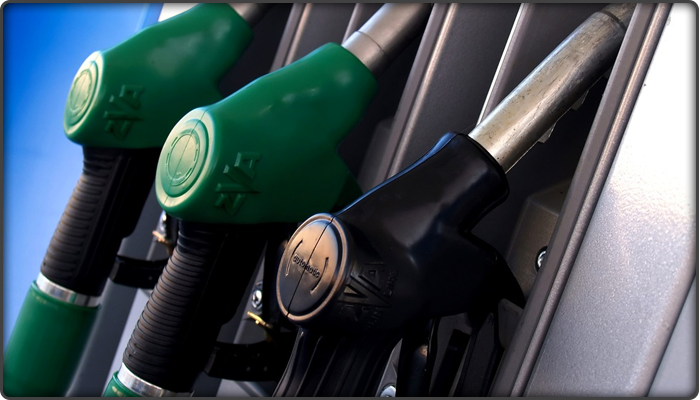
Petrol
Petrol is formed from shorter and lighter chains of hydrocarbons than diesel. Petrol is lightweight, extremely volatile and evaporates quickly. These qualities contribute to gasoline powered engines having more horsepower and acceleration than an equivalent diesel engine. However, petrol is not as efficient a fuel as diesel. Petrol produces approximately 124,000 British Thermal Units (BTUs) of energy per 3.79 litres while a diesel engine produces approximately 139,000 BTUs of energy per 3.79 litres.
Spark ignition engines are designed to burn petrol in a controlled process called deflagration. In some cases, however, the unburned mixture can auto ignite (detonate from pressure and heat alone, rather than ignite from the spark plug at exactly the right time), which causes rapid pressure rise that can damage the engine. This phenomenon is often referred to as engine knocking or end-gas knock. One way to reduce knock in spark ignition engines is to increase the petrol's resistance to auto ignition, which is expressed by its octane rating.
South Africa's largest city, Johannesburg is located on the Highveld at 1,753 metres above sea-level. The South African AA recommends 95 octane petrol (gasoline) at low altitude and 93 octane for use in Johannesburg because "The higher the altitude the lower the air pressure, and the lower the need for a high octane fuel as there is no real performance gain".